


Hospice Myths Debunked : What I Wish More Families Knew About Hospice Care
Over my years in healthcare, I’ve had countless conversations with families about hospice. And one thing I’ve learned is that sometimes the hardest part of hospice isn't the care itself. It's the word hospice. For many families, that word carries fear. They may believe hospice means giving up, that it is only for someone's final days, or that choosing hospice means they can no longer make decisions about their care. Those misconceptions matter because they can prevent patients and families from receiving support that could make an incredibly difficult season more comfortable and meaningful. So, I want to address some of the hospice myths I hear most often—and talk about what hospice care actually means.
Myth #1: Hospice Means Giving Up
The truth: Hospice is not about giving up. It's about changing the goals of care.
When curative treatment is no longer effective, appropriate, or desired, hospice shifts the focus toward comfort, symptom management, dignity, and quality of life.
There can still be so much to hope for.
Hope for a comfortable day.
Hope for time with family.
Hope for symptoms to be controlled.
Hope for a meaningful conversation.
Hope for peace.
Hospice doesn't eliminate hope.
Sometimes it simply changes what we're hoping for.
Myth #2: Hospice Is Only for the Last Few Days of Life
This is one of the misconceptions I most wish we could change. Under the Medicare hospice benefit, a patient may qualify when a physician certifies that the patient has a life expectancy of approximately six months or less if the illness follows its expected course.
But six months is not a deadline.
Patients can continue receiving hospice beyond six months when they remain eligible and are appropriately recertified. Unfortunately, many families wait until someone's final days before calling hospice. That can mean missing weeks or even months of support that may have benefited both the patient and the family.
One of the comments hospice professionals hear far too often is:
“I wish we had called sooner.”
Myth #3: Hospice Is a Place
Hospice isn't necessarily a building or facility.
Hospice is a type of care.
Many patients receive hospice wherever they call home. That might be a private residence, assisted living community, nursing facility, or another appropriate setting. The hospice team comes alongside the patient, family, caregivers, and facility staff when applicable to provide care and support.
For many people, that means being surrounded by familiar things and the people they love.
Myth #4: Hospice Means You Lose Your Doctor
Choosing hospice does not necessarily mean saying goodbye to the physician who has cared for you. Patients can generally continue to have their attending physician involved in their care while also receiving support from the hospice medical director and interdisciplinary hospice team.
Hospice is designed to add a specialized layer of care—not simply take relationships away.
Myth #5: Hospice Means Someone Will Be at the House 24/7
This is an important misconception to clear up before hospice begins. Hospice provides an interdisciplinary team that may include nurses, physicians, hospice aides, social workers, chaplains or spiritual-care professionals, volunteers, counselors, and others.
Team members visit according to the patient's individualized plan of care and changing needs. Hospice also provides access to support when questions or urgent needs arise, but routine hospice care does not mean a hospice employee remains in the home around the clock.
Understanding that distinction helps families plan realistically for caregiving needs.
Myth #6: Hospice Is Only for People With Cancer
Hospice serves people with many different life-limiting illnesses. Depending on an individual's condition and eligibility, hospice patients may have diagnoses such as advanced heart disease, lung disease, neurological disease, dementia, kidney or liver disease, cancer, or other serious illnesses.
Hospice eligibility is not determined simply by having one particular diagnosis. The important question is whether a person's illness and overall condition meet hospice eligibility criteria.
Myth #7: Hospice Means Stopping All Medications
Choosing hospice does not automatically mean throwing away every medication. Instead, the hospice team reviews medications in relation to the patient's terminal diagnosis, symptoms, comfort, goals of care, and overall plan. Some medications may remain very important. Others may no longer provide meaningful benefit or may not align with the patient's goals. Those decisions should be individualized and discussed with the patient's healthcare team.
The goal is not to simply "stop medicine."
The goal is to provide care that makes sense for the person we're caring for.
Myth #8: Hospice Is Only for the Patient
Hospice absolutely centers on the patient—but the family is an important part of hospice care, too. Serious illness affects everyone who loves that person.
Hospice may provide families with education about what to expect, emotional and spiritual support, assistance navigating difficult decisions, caregiver guidance, respite services when appropriate, and bereavement support following a loved one's death.
Sometimes the greatest gift we can give a family is helping them understand that they don't have to navigate this season alone.
Myth #9: Once You Choose Hospice, You Can't Change Your Mind
Hospice is a choice.
A patient or their authorized representative can choose to revoke the hospice benefit if they decide they want to pursue treatment outside the hospice plan of care. And if circumstances change later and the patient again meets eligibility requirements, hospice may be elected again.
Choosing hospice doesn't mean surrendering your voice or your right to make decisions.
Patients remain at the center of their care.
Myth #10: You Should Wait Until the Doctor Brings Up Hospice
Families do not have to be afraid to ask about hospice.
If you are seeing significant changes in someone you love—more frequent hospitalizations, worsening symptoms, increasing weakness, declining ability to perform everyday activities, or an overall decline despite treatment—it may be appropriate to begin asking questions.
Asking about hospice doesn't mean you're choosing hospice that day.
It simply means you're gathering information. And I believe families make better decisions when they have information before they're in the middle of a crisis.
Hospice Is About Living, Too
If I could change one misconception about hospice, it would be the idea that hospice is simply about dying. Hospice certainly acknowledges the reality of a life-limiting illness. We don't pretend that reality isn't there.
But so much of what hospice professionals actually do is about living.
How can we make today more comfortable?
What matters most to this patient?
Who do they want beside them?
What symptoms are keeping them from enjoying their day?
What does this family need in order to feel more supported?
Those are hospice questions.
At BeyondFaith Hospice, we believe every person deserves to be treated with dignity, compassion, and respect—and every family deserves honest information when making decisions about care.
If you're wondering whether hospice might be appropriate for someone you love, you don't have to have all the answers before you call.
Start with a conversation.
Ask the questions.
Learn what's available.
Because understanding hospice doesn't mean you're giving up.
It means you're making sure you understand every option available for the person you love.
With gratitude,
Becky Richardson, RN, BSN
Becky Richardson, RN, BSN
Owner & CEO
BeyondFaith Hospice
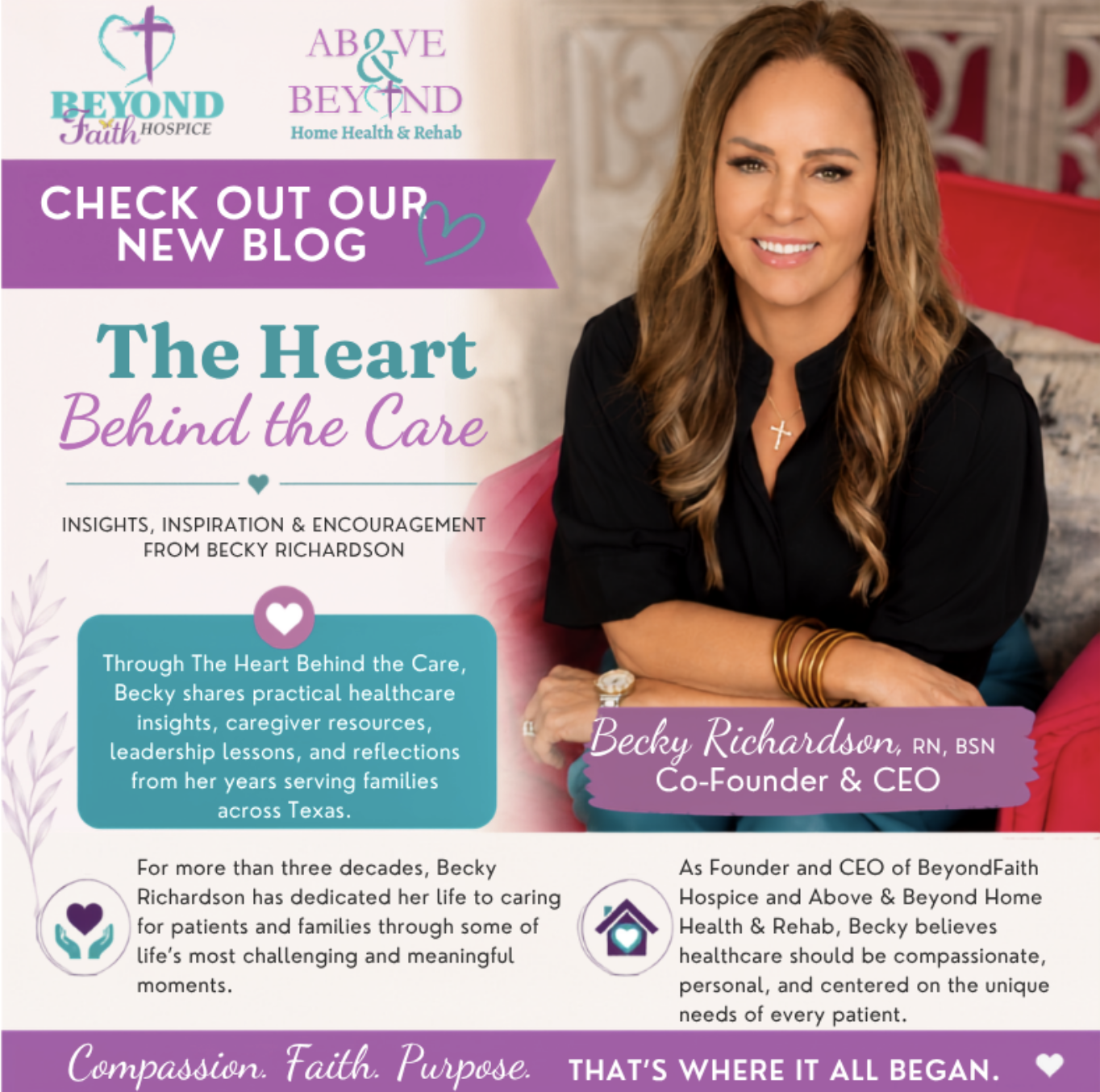
For more than three decades, Becky Richardson RN, BSN has dedicated her life to caring employees, patients and families through some of life's most challenging and meaningful moments. As Co-Founder and CEO of BeyondFaith Hospice and Above & Beyond Home Health & Rehab, Becky believes healthcare should be compassionate, personal, and centered on the unique needs of every patient. Each month, through The Heart Behind the Care, Becky will share practical healthcare insights, caregiver resources, leadership lessons, and reflections from her years serving families across Texas.


.svg)
.svg)
