


How Long Can Someone Receive Hospice Care?
Understanding the “Six-Month Rule” and What It Really Means One of the questions families often ask when considering hospice is: “How long can my loved one receive hospice care?” Many people have heard that hospice is only available for six months. Because of that, families sometimes worry about starting hospice “too soon” or believe they should wait until the very end of life before asking for help. After more than three decades of caring for patients and families, I want families to understand something very important: Hospice is not limited to six months. The six-month guideline is about eligibility for hospice, not a deadline for how long someone is allowed to receive care.
What Does the Six-Month Guideline Actually Mean?
Under the Medicare hospice benefit, a patient may qualify for hospice when physicians certify that the patient has a life expectancy of six months or less if the terminal illness runs its normal course. But predicting exactly how long someone will live is impossible. Every person is different. Every disease progresses differently.
Some patients decline more quickly than anticipated, while others stabilize and live considerably longer than expected. If a patient lives beyond six months, that does not automatically mean hospice care ends. As long as the patient continues to meet hospice eligibility requirements and the hospice physician recertifies that the patient remains terminally ill, hospice care can continue. Medicare provides hospice coverage through two initial 90-day benefit periods, followed by an unlimited number of 60-day benefit periods for patients who continue to qualify.
That means there is no predetermined maximum number of days someone can receive hospice care simply because they have reached the six-month mark.
What Happens if My Loved One Gets Better?
Sometimes something wonderful happens: a patient's condition stabilizes or improves to the point that he or she no longer meets hospice eligibility requirements. When that happens, the patient may be discharged from hospice. And that should never be viewed as a failure.
Hospice isn't about counting down someone's days. It's about providing the right care for the person's needs at that particular time. If a patient's condition later declines and the patient once again meets hospice eligibility requirements, he or she may be able to return to hospice care.
Can a Patient Choose to Leave Hospice?
Yes.
Choosing hospice does not mean giving away control over your healthcare decisions. A patient has the right to revoke the hospice benefit if he or she decides to pursue treatment for the terminal illness or simply no longer wishes to receive hospice services. If circumstances change later and the patient again qualifies for hospice, the patient may elect hospice again.
Families should never feel that beginning hospice locks them into a decision they cannot change.
Why Do So Many Families Wait?
Over the years, I have heard families tell us:
“We wish we had called sooner.”
I hear those words far more often than I hear someone say they started hospice too early. Unfortunately, misconceptions about hospice cause many families to wait until the final days—or sometimes the final hours—of a loved one's life.
They may think:
“We're not ready yet.”
“Mom isn't dying today.”
“We still have time.”
Or:
“If we start hospice now, what happens if she lives longer than six months?”
Those fears are understandable.
But hospice isn't designed only for someone's final few days. When appropriate, having more time with hospice can allow the care team to better understand the patient's needs, manage symptoms, provide medications and equipment related to the terminal illness, educate caregivers, offer emotional and spiritual support, and build relationships with the entire family.
That support can make an incredibly difficult season feel a little less overwhelming.
Hospice Is About How Someone Lives
I believe one of the greatest misunderstandings about hospice is that people associate it entirely with dying. Hospice certainly cares for people approaching the end of life—but the work we do is very much about living.
It's about asking:
What matters most to you today?
- Maybe it's controlling pain well enough to sit outside on the porch.
- Maybe it's having the strength to visit with grandchildren.
- Maybe it's staying at home instead of returning repeatedly to the hospital.
- Maybe it's helping a spouse feel confident caring for the person they have loved for 50 years.
- Maybe it's simply having someone available to answer the phone when a family is frightened and doesn't know what to do next.
Those moments matter.
And families deserve the opportunity to experience as many of them as possible.
Don't Let the Calendar Keep You From Asking for Help
If someone you love has a serious illness and you find yourself wondering whether hospice might be appropriate, you don't have to know the answer before making the call.
You can simply ask.
A conversation with a hospice team can help you understand your options, determine whether your loved one may qualify, and decide what feels right for your family. Learning about hospice doesn't mean giving up. And qualifying for hospice doesn't mean someone has exactly six months to live. It simply means that, based on the person's medical condition and expected course of illness, hospice may be an appropriate option for providing comfort, dignity, support, and quality of life.
At BeyondFaith Hospice, we believe families deserve honest answers, compassionate guidance, and the opportunity to make informed decisions without fear. Because none of us can put an exact timeline on life.
What we can do is make the time we have as meaningful and comfortable as possible.
With gratitude,
Becky Richardson, RN, BSN
Becky Richardson, RN, BSN
Owner & CEO
BeyondFaith Hospice
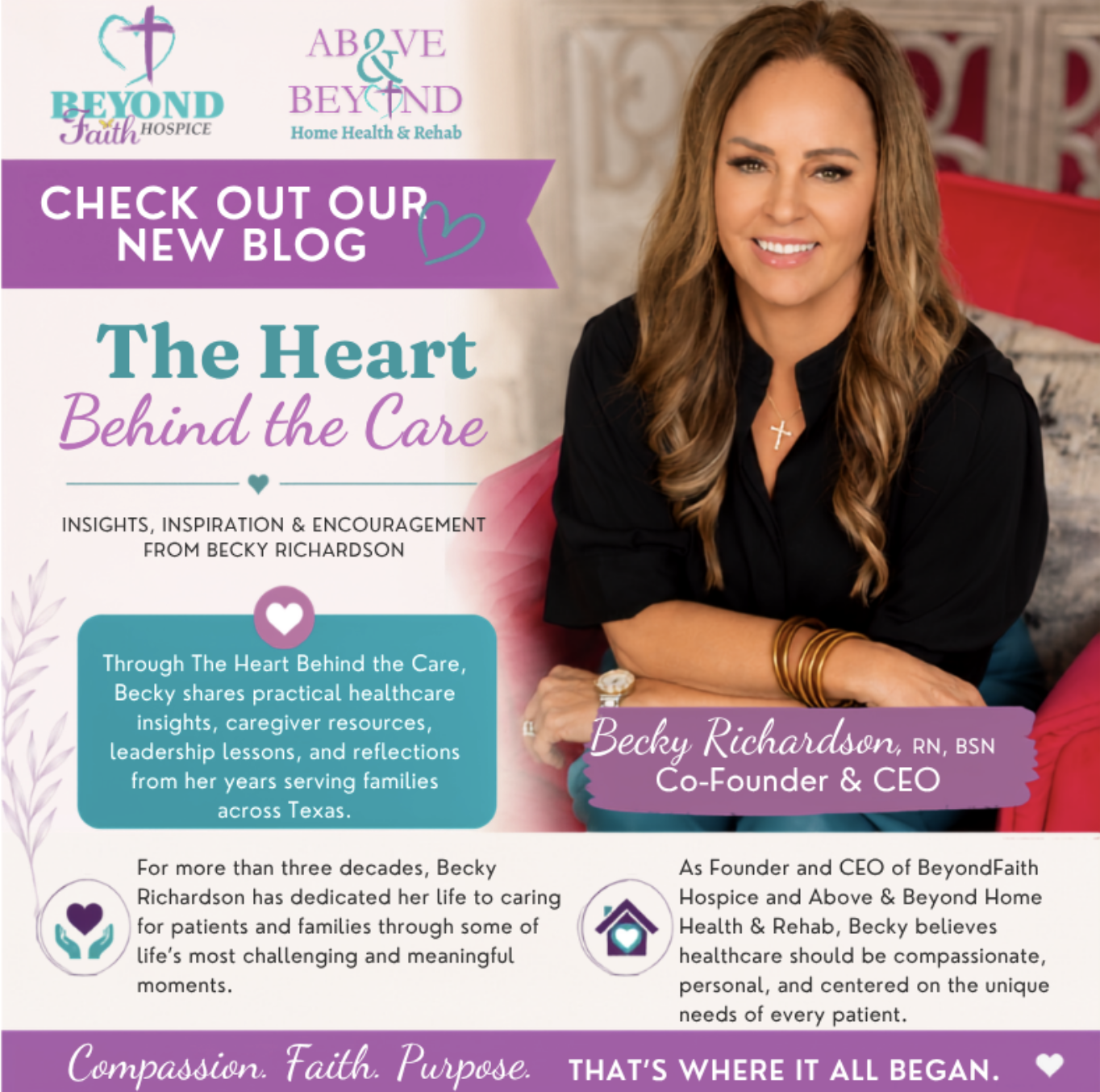
For more than three decades, Becky Richardson RN, BSN has dedicated her life to caring employees, patients and families through some of life's most challenging and meaningful moments. As Co-Founder and CEO of BeyondFaith Hospice and Above & Beyond Home Health & Rehab, Becky believes healthcare should be compassionate, personal, and centered on the unique needs of every patient. Each month, through The Heart Behind the Care, Becky will share practical healthcare insights, caregiver resources, leadership lessons, and reflections from her years serving families across Texas.


.svg)
.svg)
